It was a busy week last week.
On Thursday I travelled up to London to do three things: view a potential job, visit the British Museum exhibition The Business of Prints, and — most importantly — choose my Japanese repair papers. I visited the showroom at John Purcell Paper in south London and spent a happy hour choosing my papers. For a paper conservator, this is heaven.
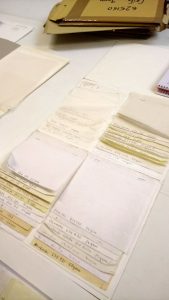 So why, you may ask, did I have to go to London — why couldn't I get samples sent to me? The thing about Japanese papers is that they often change and get discontinued. The last time I bought paper was ten years ago. It's important to see what they have, get a feel for it, look at the quality, even smell it. There are just too many to choose from.
I came away with six types of paper of varying weights (grams per square metre), one of which I bought just because I liked it — not sure I'll even use it for conservation.
So, what do I use the paper for, and why Japanese paper?
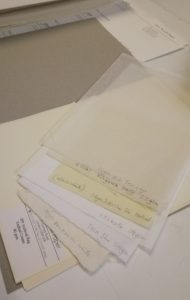
Japanese papers are made from many different plant fibres, most of which have very long fibres. Those long fibres make the paper very strong for its weight, and ideal for paper conservation. They are also good quality and usually acid-neutral.
I use Japanese paper for lining a fragile document or art work, repairing tears, strengthening weak areas, and hinging art works into mounts. The right paper depends on the weight of the art work and what you need the paper to do, so having a variety is very important. Sometimes you want your repair to be invisible; sometimes it needs to be strong enough to work for a purpose (such as in a book). It needs to be strong enough to hold a tear together — but not so strong that the repair becomes the strongest part of the work, causing tears to appear where there is no repair. The Holy Grail is finding the perfect repair paper for the job at hand.
Halloween
As it's nearly Halloween, I include a photo of the skull and crossbones woodcut I saw on display at the BM. It is believed to have been used in the 1750s, pasted to a house as a warning that the occupants had the plague or some other infectious disease. Enjoy!